
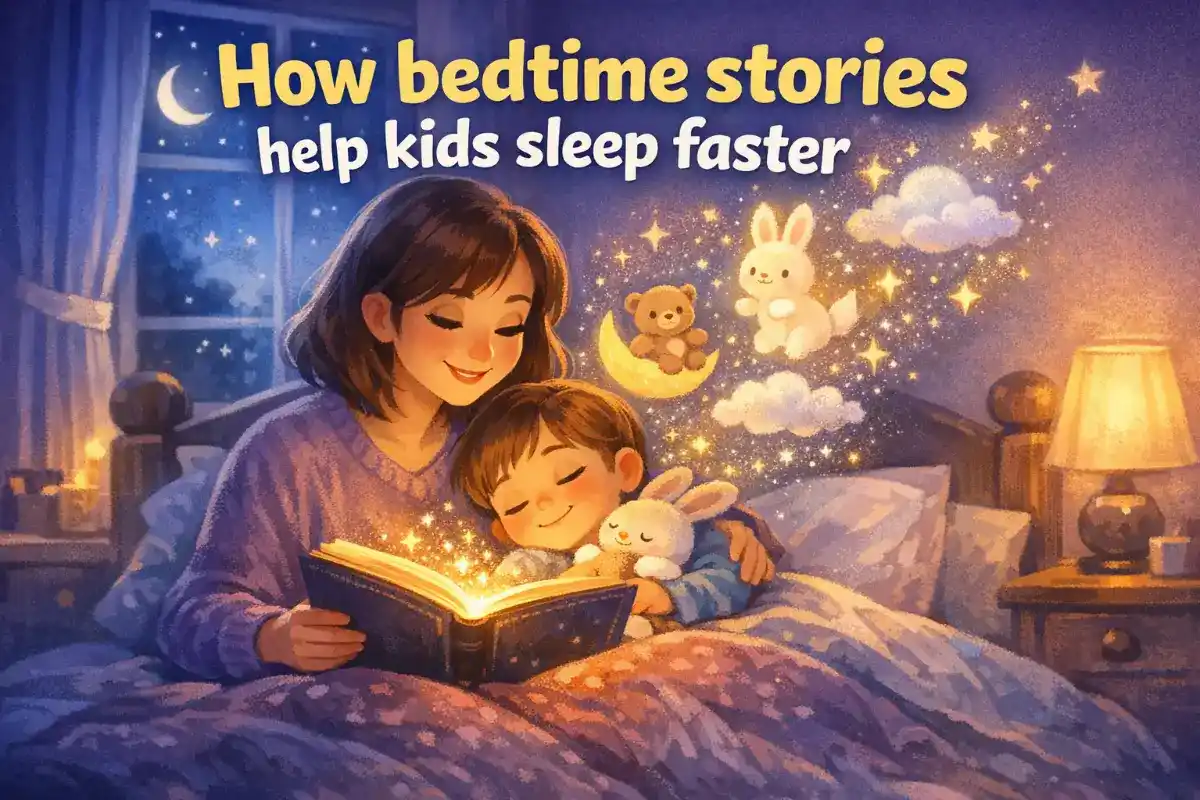
Bedtime can feel like the hardest part of the day.
You’re tired. Your child is still full of energy. Or worse—they’re tired too, but can’t seem to settle. The requests begin. One more hug. One more drink. One more minute.
If this sounds familiar, you’re not alone.
The good news is that something simple—and deeply powerful—can change this pattern: bedtime stories. When used intentionally, they can help kids fall asleep faster, reduce resistance, and create calm, connected nights.
Let’s explore how and why this works—and how you can start tonight. 🌙
How bedtime stories help kids sleep faster (and reduce night struggles) and build a calm bedtime rhythm
Many parents think bedtime stories are just a sweet tradition.
But in reality, they are a powerful tool for shaping your child’s sleep behavior.
Bedtime stories help kids sleep faster because they create a predictable and calming transition from activity to rest.
During the day, your child’s brain is stimulated:
- Screens
- Noise
- Movement
- Emotions
At night, the brain needs a clear signal: it’s time to slow down.
That’s where stories come in.
They act as a bridge between the busy day and restful sleep.
Instead of going from high energy straight to bed (which often leads to resistance), stories gently guide your child into a calmer state.
Over time, this becomes a pattern:
- Story starts → body relaxes
- Voice softens → breathing slows
- Story ends → sleep follows
This repetition builds a natural sleep rhythm.
And that rhythm reduces struggles.
👉 Keep reading here: Bedtime Stories for Kids: 10 Calming Stories for Sleep
Why kids struggle at bedtime (and what most parents miss)
Before understanding the solution, it’s important to understand the problem.
Many children don’t resist bedtime because they’re “difficult.”
They struggle because:
- Their minds are still active
- They feel disconnected after a busy day
- They haven’t transitioned emotionally
- Their routine is inconsistent
Often, parents try to fix bedtime with rules:
“Go to bed.”
“Close your eyes.”
“Stop getting up.”
But sleep doesn’t work well with pressure.
Children need co-regulation first.
They need to feel calm with you before they can calm themselves.
That’s exactly what bedtime stories provide.
👉 Keep reading here: Bedtime Stories for Babies: 10 Gentle Tales for Fast Sleep
Bedtime routine for kids: how stories create structure and security
A strong bedtime routine for kids is one of the most effective ways to improve sleep.
And stories play a central role in that routine.
Why?
Because they are predictable.
Children thrive on knowing what comes next.
When the same sequence happens every night, the brain begins to anticipate sleep.
For example:
- Bath
- Pajamas
- Lights dim
- Story
- Sleep
The story becomes a signal.
Not just entertainment—but a cue that sleep is near.
This reduces:
- Anxiety
- Resistance
- Delays
And increases:
- Cooperation
- Calmness
- Faster sleep onset
Consistency matters more than perfection.
Even a short story, repeated nightly, can create lasting results.
👉 Keep reading here: Classic Stories for Kids: 15 Timeless Tales to Read
Bedtime stories benefits: calming the brain and body naturally
There’s a reason why bedtime stories help kids sleep faster—and it’s not just emotional. It’s biological.
When you read in a calm voice, several things happen:
1. The nervous system slows down
Your child shifts from alert (active mode) to relaxed (rest mode)
2. Breathing becomes deeper and slower
This signals safety to the body
3. Stress levels decrease
Gentle storytelling reduces cortisol (stress hormone)
4. Melatonin production increases
This is the hormone that helps us fall asleep
Unlike screens, which stimulate the brain, stories do the opposite.
They gently prepare the body for sleep.
And they do it naturally.
How to help kids fall asleep faster with bedtime stories
If you want to see real results, it’s not just about reading a story.
It’s about how you do it.
Here’s a simple approach that works:
1. Slow everything down
Don’t rush the story. Pause. Let your child imagine.
2. Lower your voice
A soft tone helps regulate your child’s emotions.
3. Choose calming stories
Avoid excitement, loud action, or tension before bed.
4. Keep the environment quiet
Dim lights. Reduce noise. Create a cozy space.
5. Stay consistent
The same routine each night builds trust and predictability.
Over time, your child will associate your voice and the story with sleep.
And that’s when the magic happens.
👉 Keep reading here: Short Stories for Kids: 10 Calm Tales for Sleep
Replace screen time with bedtime stories (without resistance)
One of the biggest challenges today is screen time.
Many parents rely on it to get through the evening.
But screens can actually make sleep harder.
They:
- Stimulate the brain
- Delay melatonin release
- Increase restlessness
So how do you replace screens without tantrums?
Gradually.
Start by:
- Introducing a story after screen time
- Then slowly reducing screen duration
- Replacing it fully with stories over time
Make the story feel special.
A moment of connection.
Not a rule—but a reward.
Children don’t just give up screens.
They trade them for something better.
👉 Keep reading here: Animal Stories for Kids: 10 Heartwarming Tales
Emotional connection: the hidden reason bedtime stories work
One of the most overlooked benefits of bedtime stories is connection.
During the day, life moves fast.
Parents are busy. Kids are active.
But bedtime creates a pause.
A moment to reconnect.
When you read to your child:
- They feel safe
- They feel seen
- They feel close to you
This emotional security reduces anxiety.
And when anxiety decreases…
Sleep becomes easier.
Sometimes, what looks like a sleep problem is actually a connection need.
Stories meet that need gently.
👉 Keep reading here: Educational Stories for Kids: 10 Tales That Teach Values
Common bedtime mistakes that make sleep harder
Even with good intentions, some habits can make bedtime more difficult.
Here are common mistakes to avoid:
1. Starting bedtime too late
Overtired children often resist sleep more
2. Inconsistent routines
Changing patterns confuse the brain
3. Stimulating activities before bed
Screens, loud play, or bright lights delay sleep
4. Rushing the process
Children need time to transition
5. Skipping connection
Going straight to “sleep now” can increase resistance
Bedtime stories help correct all of these naturally.
Creating a calming bedtime environment that supports stories
Your environment matters.
Even the best story won’t work as well in a chaotic setting.
To support better sleep:
- Dim the lights
- Keep the room cool and quiet
- Use soft tones and gentle movements
- Reduce distractions
Think of bedtime as a slow landing.
Not a sudden stop.
Stories are the runway.
Long-term benefits of bedtime stories for sleep and development
The impact of bedtime stories goes far beyond sleep.
Over time, they support:
Better emotional regulation
Children learn to process feelings calmly
Improved language skills
Listening builds vocabulary and understanding
Stronger parent-child bond
Daily connection builds trust
Healthier sleep habits
Consistent routines shape lifelong patterns
So while the immediate goal may be easier nights…
The long-term benefits are even greater.
Conclusion: small moments that transform bedtime
If bedtime feels like a daily struggle, you don’t need a drastic change.
You need a gentle shift.
Bedtime stories help kids sleep faster (and reduce night struggles) because they meet children where they are.
They don’t force sleep.
They invite it.
Through calm, connection, and consistency, stories turn bedtime into something your child can look forward to—not resist.
And over time…
The nights become quieter.
The struggles become smaller.
And sleep comes more easily. 🌙
FAQs
How long should a bedtime story be for better sleep?
Shorter is better—around 5 to 10 minutes. The goal is calm, not stimulation.
Can bedtime stories really reduce night wakings?
Yes. They improve emotional security and routine, which can lead to more stable sleep patterns.
What kind of stories are best before bed?
Calm, gentle stories with soft pacing and no excitement or tension.
At what age should I start bedtime stories?
You can start as early as infancy. Even babies benefit from the sound of a calm, familiar voice.