
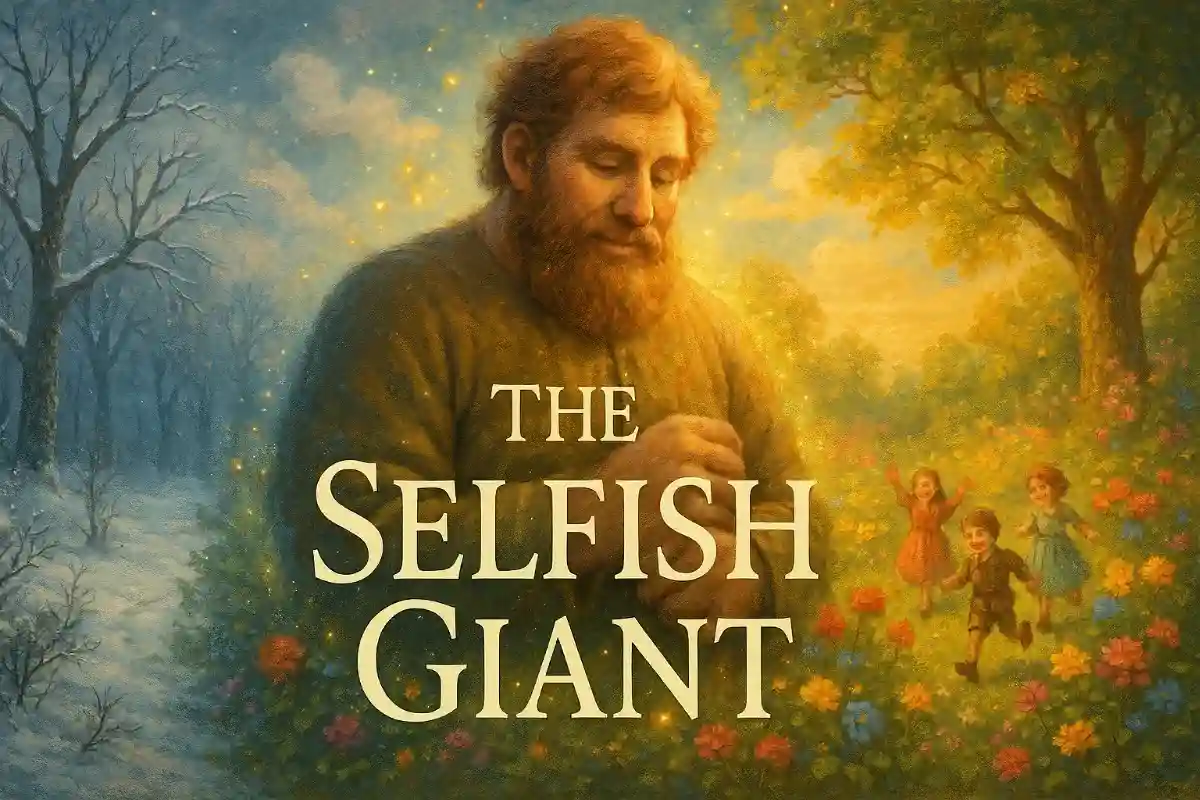
At the end of a long day, when your house is finally quiet and your child is tucked in, you don’t need something loud or complicated.
You need one of the Best classic stories that feels safe, calm, and steady.
The Selfish Giant is one of those stories. It is soft. It is meaningful. And when told in a gentle way, it becomes a peaceful bedtime moment you can use tonight.
Below, you’ll find a calm retelling of The Selfish Giant fairy tale, followed by simple, practical ways to use it as part of your child’s bedtime routine.
Take a slow breath. Let’s begin.
Best classic stories: The Selfish Giant
Every afternoon, when school was over, the children of the village would wander into the Giant’s garden and play.
It was a large and lovely garden, with soft green grass and here and there beautiful flowers like stars.
Twelve peach trees stood there, and in the spring they blossomed in delicate shades of pink and pearl, and in the autumn they bore rich fruit.
Birds rested in the branches and sang so sweetly that the children would stop their games to listen.
“How happy we are here,” they would say to one another.
One day the Giant returned. He had been away for seven years visiting his friend, the Cornish ogre, and when those years were over he decided to go back to his own castle. As he stepped into his garden, he saw the children playing.
“What are you doing here?” he cried in a very gruff voice, and the children ran away.
“My own garden is my own garden,” said the Giant. “Anyone can understand that, and I will allow nobody to play in it but myself.”
So he built a high wall all around it and put up a notice-board:
TRESPASSERS WILL BE PROSECUTED
He was a very selfish Giant.
The poor children now had nowhere to play. They tried to play on the road, but the road was dusty and full of hard stones, and they did not care for it. They would wander around the high wall when lessons were over and talk about the beautiful garden inside.
“How happy we were there,” they said.
Then Spring came, and all over the country there were little blossoms and little birds. Only in the garden of the Selfish Giant it was still winter.
The birds did not care to sing in it, because there were no children, and the trees forgot to blossom. Once a lovely flower lifted its head out of the grass, but when it saw the notice-board it felt so sorry for the children that it slipped back into the ground again and went to sleep.
The only ones who were pleased were the Snow and the Frost.
“Spring has forgotten this garden,” they cried, “so we will live here all year round.”
The Snow covered up the grass with her great white cloak, and the Frost painted all the trees silver. Then they invited the North Wind to stay with them, and he came. He was wrapped in furs and roared all day about the garden, blowing the chimney-pots down.
“This is a delightful spot,” he said. “We must ask the Hail on a visit.”
So the Hail came. Every day for three hours he rattled on the roof of the castle until he broke most of the slates, and then he ran round and round the garden as fast as he could go. He was dressed in gray and his breath was like ice.
“I cannot understand why the Spring is so late in coming,” said the Selfish Giant, as he sat at the window and looked out at his cold white garden. “I hope there will be a change in the weather.”
But the Spring never came, nor the Summer. The Autumn gave golden fruit to every garden, but to the Giant’s garden she gave none.
“He is too selfish,” she said.
So it was always winter there, and the North Wind, and the Hail, and the Frost, and the Snow danced about through the trees.
One morning the Giant was lying awake in bed when he heard some lovely music. It sounded so sweet to his ears that he thought it must be the King’s musicians passing by. In truth, it was only a little linnet singing outside his window, but it had been so long since he had heard a bird sing in his garden that it seemed the most beautiful music in the world.
“I believe the Spring has come at last,” said the Giant, and he jumped out of bed and looked out.
What did he see?
He saw a most wonderful sight. Through a little hole in the wall the children had crept in, and they were sitting in the branches of the trees. In every tree that he could see there was a child. And the trees were so glad to have the children back again that they had covered themselves with blossoms and were gently waving their arms above the children’s heads. The birds were flying about and twittering with delight, and the flowers were lifting their heads out of the green grass and laughing.
It was a lovely scene.
Only in one corner it was still winter. It was the farthest corner of the garden, and in it stood a little boy. He was so small that he could not reach up to the branches of the tree, and he was wandering around it, crying bitterly. The poor tree was still covered with Frost and Snow, and the North Wind was blowing and roaring above it.
“Climb up! Climb up!” said the tree, bending its branches down as low as it could, but the boy was too tiny.
And the Giant’s heart melted as he looked out.
“How selfish I have been!” he said. “Now I know why the Spring would not come here. I will put that poor little boy on the top of the tree, and then I will knock down the wall, and my garden shall be the children’s playground forever and ever.”
He was truly sorry for what he had done.
So he went downstairs and opened the front door quite softly, and went out into the garden. But when the children saw him, they were so frightened that they all ran away, and the garden became winter again.
Only the little boy did not run, for his eyes were so full of tears that he did not see the Giant coming. And the Giant stole up behind him and gently took him in his hand, and lifted him up into the tree.
And the tree broke at once into blossom, and the birds came and sang on it, and the little boy stretched out his two arms and flung them around the Giant’s neck and kissed him.
When the other children saw that the Giant was not wicked any longer, they came running back, and with them came the Spring.
“It is your garden now, little children,” said the Giant, and he took a great axe and knocked down the wall.
And when the people were going to market at twelve o’clock they found the Giant playing with the children in the most beautiful garden they had ever seen.
All day long they played, and in the evening they came to the Giant to bid him good-bye.
“But where is your little companion?” he said. “The boy I put into the tree.”
The Giant loved him best because he had kissed him.
“We do not know,” answered the children. “He has gone away.”
“You must tell him to be sure and come tomorrow,” said the Giant.
But the children said that they did not know where he lived, and had never seen him before; and the Giant felt very sad.
Every afternoon, when school was over, the children came and played with the Giant. But the little boy whom the Giant loved was never seen again. The Giant was very kind to all the children, yet he longed for his first little friend.
“How I would like to see him,” he used to say.
Years passed, and the Giant grew very old and feeble. He could not play about anymore, so he sat in a large armchair and watched the children at their games, and admired his garden.
“I have many beautiful flowers,” he said, “but the children are the most beautiful flowers of all.”
One winter morning he looked out of his window as he was dressing. He did not hate the winter now, for he knew that it was merely the Spring asleep, and that the flowers were resting.
Suddenly he rubbed his eyes in wonder.
It certainly was a marvelous sight.
In the farthest corner of the garden was a tree covered with lovely white blossoms. Its branches were golden, and silver fruit hung down from them, and underneath it stood the little boy he had loved.
Downstairs ran the Giant in great joy and out into the garden. He hastened across the grass and came near to the child.
And when he came quite close, his face grew red with anger, and he said, “Who has dared to wound you?”
For on the palms of the child’s hands were the marks of two nails, and the marks of two nails were on the little feet.
“Who has dared to wound you?” cried the Giant. “Tell me, that I may take my big sword and slay him.”
“Nay,” answered the child, “but these are the wounds of Love.”
“Who are you?” said the Giant, and a strange awe fell upon him, and he knelt before the little child.
And the child smiled on the Giant, and said to him, “You let me play once in your garden; today you shall come with me to my garden, which is Paradise.”
And when the children ran in that afternoon, they found the Giant lying dead under the tree, all covered with white blossoms.
👉 Continue with this classic story: Classic Bedtime Stories: 15 Timeless Tales to Calm Kids
Why this is one of the Best classic stories for kids at bedtime
When you’re choosing among the Best classic stories for kids, you’re not just looking for something famous. You’re looking for something that helps your child settle.
The story of the selfish giant works beautifully at night because:
- It has a clear beginning, middle, and end.
- The conflict is simple and not frightening.
- The emotional change is gentle and hopeful.
- The message is warm, not heavy.
There are no fast scenes. No loud surprises. No confusing twists.
Just winter… then spring.
For a child who feels overstimulated at night, that rhythm matters.
👉 Continue with this story: Bedtime Stories for Kids: 10 Calming Stories for Sleep
How to tell The Selfish Giant in a calm, sleep-friendly way
Even classic stories for kids can feel too dramatic if told with too much energy.
Here’s how to make this story especially soothing tonight:
1. Lower your voice gradually
Start the story in your normal soft tone.
As the story moves from winter to spring, slow down your speech. Leave small pauses between sentences.
Let the quiet do some of the work.
2. Soften the “winter” part
When describing the snow and frost, keep your tone gentle. Avoid dramatic words.
Instead of “angry winter,” say “quiet winter.”
Instead of “howling wind,” say “cold wind.”
You are shaping the emotional temperature of the room.
👉 Continue with this story: Short Stories for Kids: 10 Calm Tales for Sleep
3. Emphasize warmth at the end
When the giant’s heart changes, slow your pace even more.
You can say:
“His heart felt warm… soft… calm.”
These words help your child feel those sensations too.
What this story teaches without overstimulating
You may worry about stories that feel too emotional before bed.
But The Selfish Giant is not loud or scary. It gently shows:
- Sharing brings happiness.
- Kindness changes people.
- Love makes spaces feel safe.
Your child does not need a long explanation.
The message settles quietly in the background, like a soft light.
If your child takes a long time to fall asleep
If bedtime feels long in your home, you are not alone.
Many parents worry:
“My child just won’t settle.”
“My child asks for more and more stories.”
“My child gets silly right before sleep.”
This story can help because it has natural pause points.
You can pause after:
- The winter arrives.
- The children return.
- The giant changes.
If your child’s eyes are already heavy, you can gently shorten the ending.
If your child wants one more story, you can retell the final spring scene slowly instead of starting something new.
This keeps bedtime predictable.
👉 Continue with this story: Educational Bedtime Stories for Kids: 10 Soothing Tales
Is The selfish giant fairy tale safe for young children?
Yes — when told gently.
There are no villains.
No frightening creatures.
No intense danger.
The emotional tone is reflective and calm.
For babies and toddlers, you can simplify:
- Focus mostly on the garden.
- Emphasize flowers, birds, sunshine.
- Shorten the “wall” part.
For preschoolers and early elementary children, you can tell the full version as written above.
Always keep your tone soft.
👉 Continue with this story: Animal Stories for Kids: 10 Heartwarming Tales
Creating a peaceful bedtime routine with classic stories for kids
Stories work best when they are part of something predictable.
You might try:
- Warm bath
- Pajamas
- Dim lights
- One calm story
- One short cuddle moment
- Lights out
If you use The Selfish Giant regularly, it becomes familiar.
Familiar stories feel safe.
And safe stories help your child rest.
You do not need to read five books.
Often, one meaningful story told slowly is enough.
👉 Continue with this story: Bedtime Stories for Babies: 10 Gentle Tales for Fast Sleep
When you want to avoid screens at night
If you are trying to reduce screens before bed, this story is a beautiful alternative.
There are no flashing lights.
No background noise.
No fast images.
Just your voice.
Your voice is steady.
Your voice is safe.
Your voice tells your child it is time to rest.
That connection matters more than perfect storytelling.
How long should this story be at bedtime?
You can adjust the length easily.
For babies:
3–5 minutes. Focus on the garden turning warm and bright.
For toddlers and preschoolers:
5–8 minutes. Tell the full story slowly.
For older children:
10 minutes, with small reflective pauses.
If your child asks questions, answer briefly and calmly.
You can say, “The giant learned to be kind. And now the garden feels happy.”
Then guide gently back toward sleep.
If you worry about “big themes” before bed
Some parents worry that stories about change or regret might feel heavy at night.
But the story of the selfish giant moves toward comfort, not tension.
Winter ends.
The wall comes down.
The garden blooms.
It closes with warmth.
That emotional arc is safe for bedtime.
A gentle reminder for tired parents
You do not need to perform.
You do not need dramatic voices.
You do not need to make the story perfect.
Your calm presence is what matters most.
If you stumble over a word, it’s okay.
If you shorten the story because you’re exhausted, that’s okay too.
The goal is not perfection.
The goal is connection.
FAQs about using The Selfish Giant at bedtime
What is the ideal age for this story?
This story works well for ages 3–8 when told in a simplified, gentle way. For babies, shorten and focus on the warm garden imagery.
Is this story too long for bedtime?
Not if told slowly and calmly. You can always shorten the middle and focus on the transformation to spring.
Should I explain the moral?
No long explanation is needed. The emotional shift from cold to warm is enough. Children absorb meaning naturally.
Can I use this story every night?
Yes. Repetition often helps children fall asleep faster because the story feels predictable and safe.
A soft ending for tonight
When you finish telling The Selfish Giant, let your voice grow even quieter.
You might say:
“And now the garden is calm… the flowers are resting… and everything feels warm and safe.”
Then pause.
Place your hand gently on your child’s back.
Let the room be still.
These small moments — your steady voice, the soft story, the shared quiet — are not small at all.
They are building safety.
They are building trust.
They are building love.
Classic stories for kids have lasted for generations because they hold something simple and true.
Tonight, this one can hold your child gently as they drift toward sleep.
And you can exhale, knowing you gave them something calm, something safe, and something meaningful.
That is more than enough.