
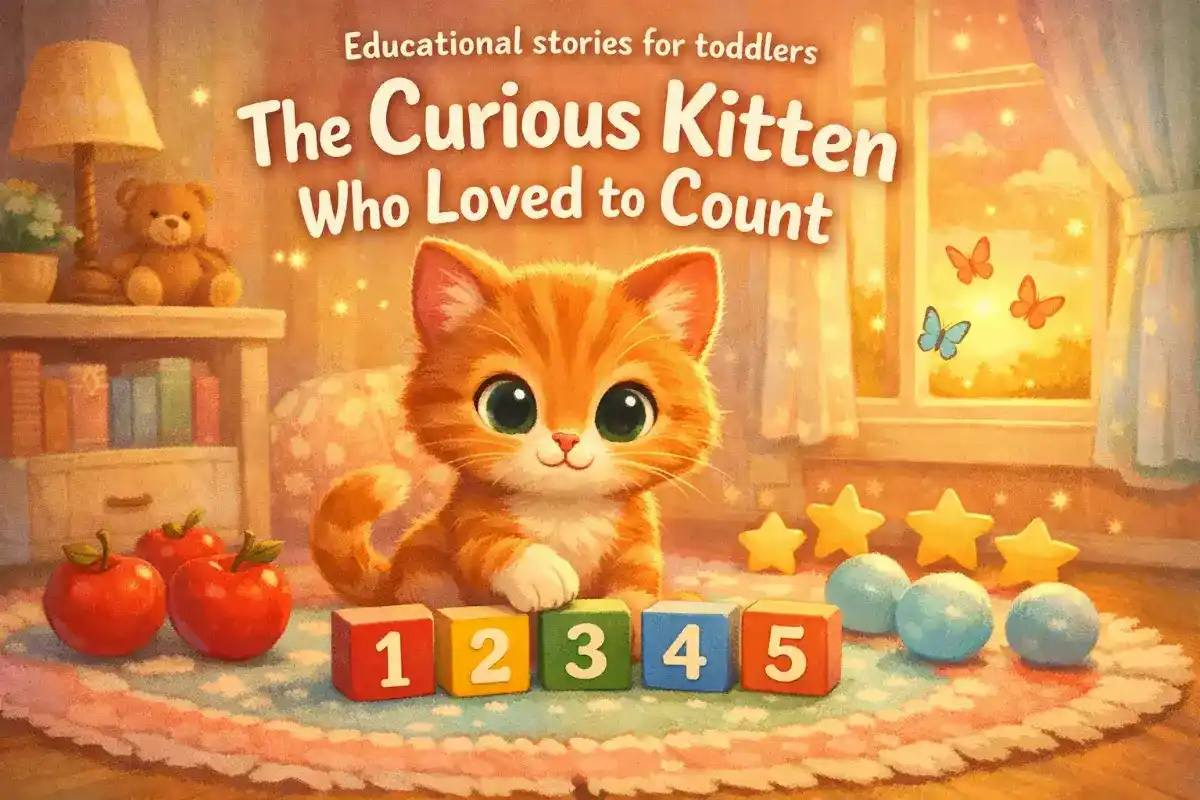
At the end of a long day, when your little one is finally in pajamas and the house feels quieter, you may be looking for Educational stories for toddlers that are gentle, safe, and simple enough to use tonight.
You want something calming.
Something predictable.
Something that helps your child wind down — not wind up.
Below, you’ll find a soft, original bedtime story you can read right now. It weaves simple counting into a cozy rhythm that supports rest, not stimulation.
Take a slow breath. Let your voice soften.
And begin.
Educational stories for toddlers: The curious Kitten who loved to count
In a small, cozy house at the edge of a quiet meadow, there lived a tiny gray kitten.
She had soft paws, bright whiskers, and a curious little nose.
Her favorite thing in the whole world was counting.
Not fast counting.
Not loud counting.
Slow, gentle counting.
Every evening, just before bedtime, the kitten liked to explore the house and count the small, peaceful things around her.
One night, as the sky turned pink and gold, the kitten padded softly into the living room.
She saw one big, round pillow on the floor.
“One pillow,” she whispered.
She touched it gently with her paw.
Then she saw two cozy slippers beside the couch.
“One… two slippers,” she counted quietly.
She liked how the numbers felt — calm and steady.
The kitten walked to the window.
Outside, she saw three glowing fireflies floating in the twilight.
“One… two… three,” she whispered, her eyes growing softer.
The fireflies blinked slowly, as if they were counting too.
Next, she padded into the kitchen.
On the table were four shiny apples in a wooden bowl.
“One… two… three… four apples.”
She did not rush.
She did not shout.
She simply counted and smiled.
In the hallway, she found five picture frames hanging on the wall.
One frame held a photo of her family.
Another showed a sunny day in the meadow.
She counted each one carefully.
“One… two… three… four… five.”
Her steps grew slower now.
Her body felt warm.
Her tail moved softly behind her.
When she reached the bedroom, she saw six tiny stars glowing on her nightlight.
They shimmered gently on the wall.
“One… two… three… four… five… six.”
The kitten yawned a small, sleepy yawn.
On her bed were seven soft stripes on her favorite blanket.
She traced each stripe with her paw.
“One… two… three… four… five… six… seven.”
The room felt quiet.
The air felt still.
On her shelf sat eight small storybooks.
She counted their colorful spines.
“One… two… three… four… five… six… seven… eight.”
Her voice was barely louder than a whisper now.
Near her bed were nine tiny toy mice lined up neatly.
She smiled at them.
“One… two… three… four… five… six… seven… eight… nine.”
Finally, she looked up at the ceiling.
There, painted in soft glow-in-the-dark paint, were ten little stars.
She counted them very slowly.
“One… two… three… four… five… six… seven… eight… nine… ten.”
Ten stars.
Ten calm breaths.
Ten sleepy moments.
The kitten curled into a soft gray ball.
“I counted all the way to ten,” she murmured.
And with one last quiet breath, she drifted into a peaceful sleep.
The house rested.
The meadow rested.
The stars rested.
And the curious kitten who loved to count slept safely through the night.
The end.
👉 Keep reading: Educational Bedtime Stories for Kids: 10 Soothing Tales
Why Educational stories for kids work so well at bedtime
You may wonder if learning and bedtime even belong together.
The truth is, an Educational story for toddlers does not need to feel like a lesson.
It can feel like comfort.
Counting, when done slowly, creates rhythm.
Rhythm creates calm.
Calm helps your child’s body settle.
Instead of overstimulating your little one, gentle learning stories for kids give their minds something steady and predictable to hold onto.
Numbers move forward in order.
There are no surprises.
No loud moments.
No conflict.
Just soft progression.
That predictability is deeply reassuring before sleep.
👉 Keep reading: Bedtime Stories for Kids: 10 Calming Stories for Sleep
How to use this story tonight in your bedtime routine
If your child takes a long time to fall asleep, small adjustments can help.
Here is a simple, practical way to use this story right now:
- Dim the lights before you begin.
- Sit or lie beside your child.
- Place one hand gently on their back or hold their hand.
- Read the story slowly.
After each number, pause for one quiet second.
Let the silence settle.
If your child likes participation, you can whisper together:
“One… two…”
But keep it soft.
If your little one tends to get excited when counting, lower your voice even more as the numbers go higher.
By the time you reach ten, your tone should almost feel like a lullaby.
👉 Keep reading: Short Stories for Kids: 10 Calm Tales for Sleep
If your child gets overstimulated at night
Some toddlers become silly, loud, or restless before bed.
That is very common.
Instead of choosing fast-paced educational bedtime stories for kids, choose something like this — calm, repetitive, simple.
Avoid:
- Bright illustrations right before sleep
- Loud counting games
- Clapping or jumping
Choose:
- Whispered numbers
- Slow pacing
- Gentle touch
This turns an educational story into a soothing ritual instead of an activity.
Keeping bedtime safe and screen-free
If you are trying to reduce screens before bed, you are not alone.
Many parents worry that screens delay sleep or make their child more alert.
This kind of educational story for toddlers offers learning without blue light.
Your voice becomes the focus.
Your presence becomes the comfort.
There are no flashing animations.
No sudden sounds.
Just quiet connection.
That safety matters more than perfect pronunciation or perfect pacing.
👉 Keep reading: Classic Bedtime Stories: 15 Timeless Tales to Calm Kids
Making counting feel cozy, not academic
Toddlers do not need formal teaching at bedtime.
They need warmth.
You are not giving a math lesson.
You are sharing calm.
If your child skips a number, smile gently.
If they whisper “five” instead of “four,” it is okay.
The goal is rest, not accuracy.
The counting is simply a soft path toward sleep.
👉 Keep reading: Animal Stories for Kids: 10 Heartwarming Tales
When you feel too tired to read
Some nights, you are exhausted.
Your eyes are heavy.
You may think, “I don’t have the energy for this.”
On those nights, shorten the story.
Count only to five.
Or count the stars on your child’s ceiling.
Or count their breaths together.
“One breath… two breaths…”
Even a brief educational bedtime story for kids can anchor the routine.
Consistency matters more than length.
👉 Keep reading: Bedtime Stories for Babies: 10 Gentle Tales for Fast Sleep
How long should a toddler bedtime story be?
For toddlers, 5–8 minutes is usually enough.
If your child is under two, even 3–5 minutes may be perfect.
Watch their breathing.
If their breaths become slower and deeper, you are on the right track.
You do not need multiple stories.
Often, one calm learning story for kids is enough to guide them into rest.
Why predictable structure builds emotional safety
Toddlers thrive on knowing what comes next.
This story always moves from one to ten.
It always ends with sleep.
When you repeat it on different nights, your child begins to expect the rhythm.
Expectation lowers anxiety.
Lower anxiety makes it easier to fall asleep.
You are not just reading a story.
You are building a safe pattern.
Gentle variations you can try
If you want to change the setting slightly without losing calm, you can:
- Count ocean waves
- Count teddy bears
- Count quiet clouds
- Count soft raindrops
Keep the tone slow.
Keep the numbers in order.
Always end with rest.
That consistency keeps this among the most helpful educational stories for kids at bedtime.
FAQs about Educational stories for toddlers at bedtime
What age is this story best for?
This story works beautifully for ages 1–4. Older children may still enjoy it if told gently and calmly.
Is counting too stimulating before bed?
Not when done softly. Slow counting with a whisper can actually slow breathing and promote calm.
Should I ask my child questions during the story?
At bedtime, fewer questions are better. If you invite participation, keep it minimal and quiet.
How many stories should I read each night?
One calm story is often enough. If your child asks for more, you can simply repeat the final counting scene softly.
A soft ending for you and your little one
Tonight, when you finish reading, let the last number linger in the air.
Then say something simple and warm:
“You counted so gently. Now your body can rest.”
Place your hand softly on your child’s back.
Feel their breathing.
Let the room grow still.
These quiet moments matter.
They build trust.
They build safety.
They build connection.
Educational stories for toddlers do not need bright colors or loud excitement to be meaningful.
Sometimes, the most powerful learning happens in a whisper.
And sometimes, the most important thing you offer at bedtime is not the counting at all.
It is your steady presence.
Your calm voice.
Your gentle rhythm.
Your love.
Take a slow breath.
The kitten is asleep.
The numbers are finished.
And your little one can rest safely now.