
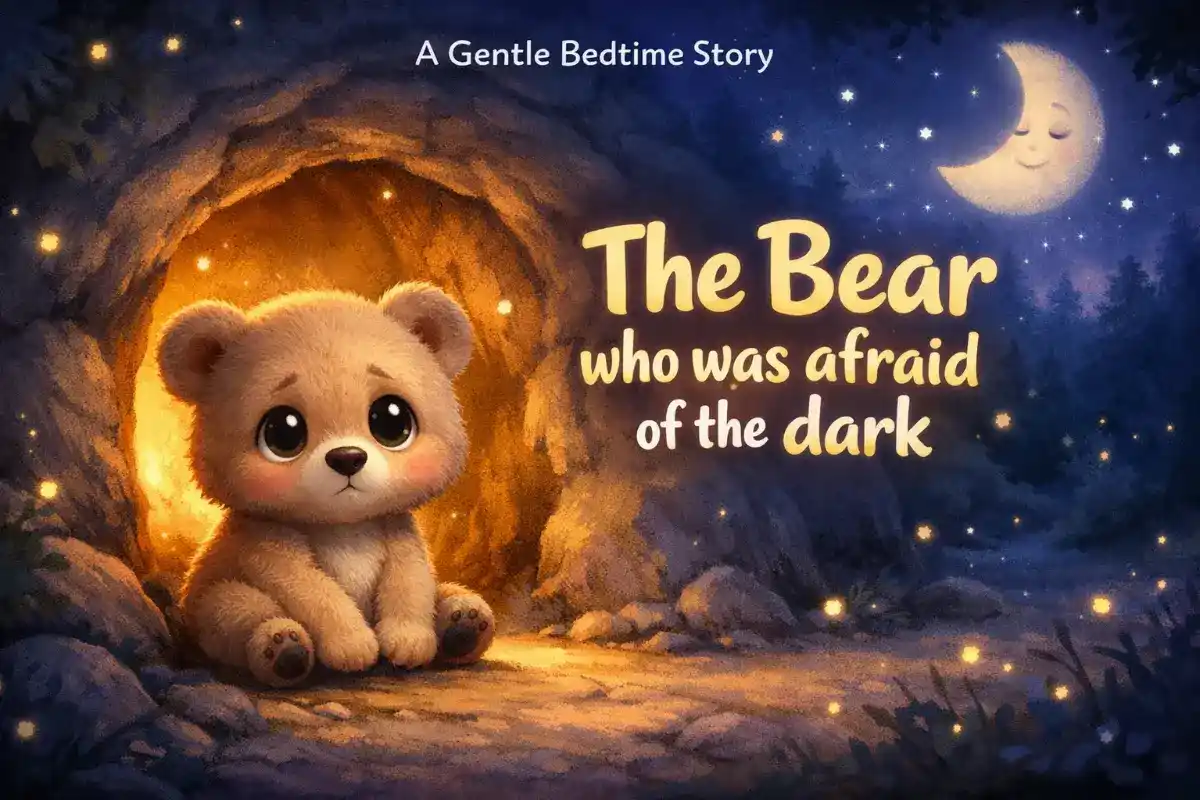
At the end of a long day, when the house is finally quiet and your little one is tucked into bed, you may find yourself searching for Animal stories for kids that truly calm instead of excite.
You do not want loud adventures. You do not want lessons that feel heavy. You just want something soft and safe.
If your child struggles with the dark, or takes a long time to fall asleep, this story is for tonight.
Animal stories for kids: The Bear Who Was Afraid of the Dark
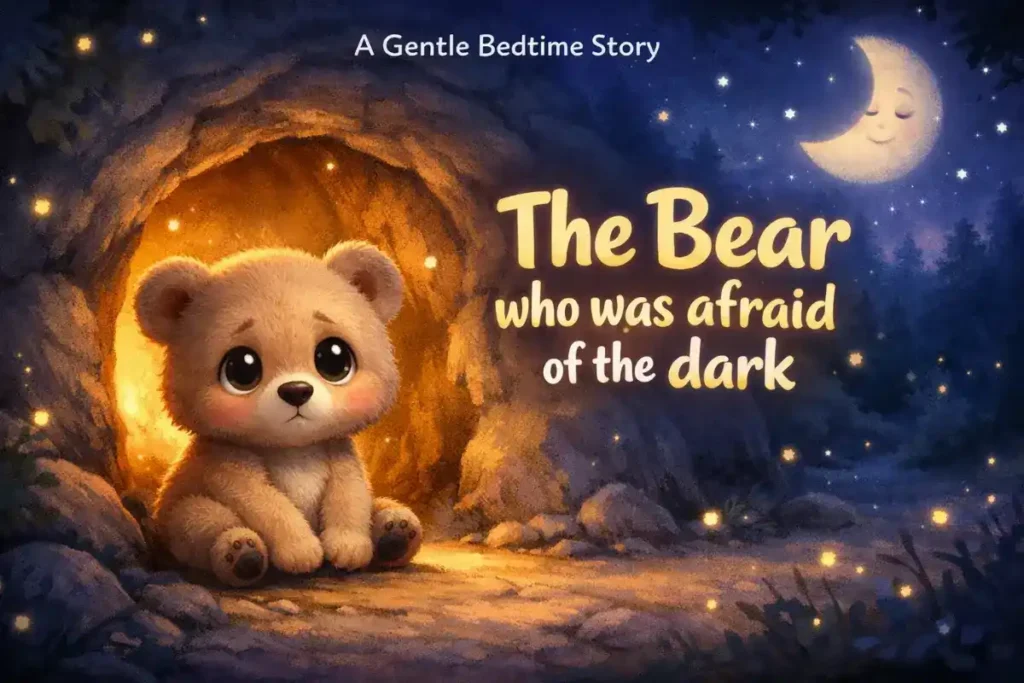
In a quiet forest surrounded by tall pine trees, there lived a small brown bear.
His name was Pedro.
Pedro was brave during the day.
He climbed over fallen logs.
He splashed gently in the cool stream.
He sniffed wildflowers and watched butterflies float through the air.
In the daylight, everything felt friendly.
But when the sun began to sink behind the trees, Pedro’s heart would beat a little faster.
The shadows grew longer.
The forest became darker.
The familiar trees looked different at night.
Pedro did not like the dark.
When the sky turned deep blue, he hurried back to his cozy cave. He curled up on his bed of soft leaves and pulled them close.
“I wish the sun would stay,” he whispered.
Outside, the forest made quiet nighttime sounds.
A soft hoot from an owl.
The gentle rustle of leaves.
The tiny chirp of crickets.
But to Pedro, those sounds felt big.
One evening, as Pedro curled into a small ball, he noticed something.
A tiny glow flickered near the entrance of his cave.
He froze.
The glow moved closer.
It was not loud.
It was not fast.
It was a small firefly.
The firefly hovered gently in the air.
“Why do you hide every night?” the firefly asked in a soft voice.
Pedro blinked.
“The dark feels too big,” he said. “I cannot see what is there.”
The firefly glowed a little brighter.
“The dark is not empty,” she said. “It is simply resting.”
Pedro listened.
“The trees are still trees,” she continued. “The stream is still the stream. They are just quiet now.”
Pedro peeked outside his cave.
The forest did look different. But it was not gone.
The moon rose slowly into the sky, casting a gentle silver light across the ground.
The shadows were softer than he remembered.
“Would you like to take a small walk?” asked the firefly.
“Just a few steps.”
Pedro’s paws felt shaky.
But he stepped outside.
One step.
Then another.
The ground felt the same beneath his feet.
Cool. Solid. Safe.
The firefly floated beside him, glowing softly.
Soon, Pedro noticed something new.
The night air was calm.
The forest was peaceful.
No busy buzzing. No bright sun.
Everything felt slower.
They walked to the stream.
Moonlight shimmered on the water like tiny stars.
“It is beautiful,” Pedro whispered.
The dark was not loud.
It was gentle.
They sat quietly for a moment.
Pedro’s breathing slowed.
His shoulders relaxed.
The firefly’s glow flickered in a calm rhythm.
“You see?” she said softly. “The night is just another kind of light.”
Pedro smiled.
He walked back to his cave, not rushing this time.
When he curled into his leaves, he did not pull them over his head.
He left a small space to watch the moon.
The owl hooted again.
But now it sounded far away. Peaceful.
Pedro closed his eyes.
The forest rested.
And so did he.
👉 Another story: Animal Stories for Kids: 10 Heartwarming Tales
Why Animal Stories Work So Well at Bedtime
There is something deeply calming about a short story about animals.
Animals feel safe.
They feel gentle.
They allow your child to explore feelings without pressure.
When your little one hears about a bear who is afraid of the dark, they may quietly recognize their own feelings. But it does not feel direct. It does not feel embarrassing.
It feels safe.
That is the quiet power of short animal stories for kids.
They create distance from fear while still offering comfort.
And at bedtime, comfort is everything.
👉 Another story: Bedtime Stories for Kids: 10 Calming Stories for Sleep
If Your Child Is Afraid of the Dark
Many children are.
You might hear:
“Can you leave the light on?”
“Stay with me.”
“I heard something.”
Nighttime can make small worries feel bigger.
Instead of arguing or explaining, you can use this short story about an animal to gently reshape how your child sees the dark.
After reading, you might whisper:
“The forest was still there. It was just resting.”
You can connect it to your child’s room:
“Your room is still your room. It is just quiet now.”
Keep it simple.
Keep it soft.
Repetition builds security.
👉 Another story: Short Stories for Kids: 10 Calm Tales for Sleep
Creating a Calm Bedtime Routine That Actually Works
If bedtime feels long or overstimulating, the solution is often not more stories.
It is more predictability.
Here is a gentle rhythm you can try tonight:
- Warm bath or face wash
- Pajamas
- Dim lights
- One short story
- One goodnight phrase
That is enough.
When you read short stories of animals like this one, read only one.
Even if your child asks for more, you can gently say:
“We will read again tomorrow.”
This helps your child’s body learn that story time leads to sleep.
Predictable.
Calm.
Safe.
Short Story About Animals for Kids: Why Simple Is Better at Night
You do not need dramatic plots or surprising endings before bed.
In fact, those can make it harder for your child to rest.
A short story about animals for kids should have:
- A gentle problem
- A calm solution
- A peaceful ending
No danger.
No villains.
No loud excitement.
In this story, the bear’s fear is met with light and understanding.
The night becomes something kind.
That shift is enough.
👉 Another story: Classic Bedtime Stories: 15 Timeless Tales to Calm Kids
For Parents Who Feel Too Tired to Do This Perfectly
You might be reading this with heavy eyes.
Maybe today was long.
Maybe your child resisted bedtime again.
You do not have to read every word exactly.
You can shorten the story.
You can say:
“There was a little bear who was afraid of the dark. A firefly showed him that the night is gentle. And he felt safe.”
That is enough.
Your voice matters more than the length.
Your presence is the comfort.
👉 Another story: Bedtime Stories for Babies: 10 Gentle Tales for Fast Sleep
Helping Overstimulated Children Wind Down
If your child gets hyper at night, try this small change:
After the story ends, do not immediately say goodnight.
Sit quietly for 20 seconds.
Place your hand softly on your child’s back.
Take one slow breath together.
You can whisper:
“The forest is resting. The bear is resting. Your body can rest too.”
Slow repetition helps the nervous system settle.
It may not work perfectly the first night.
But over time, the body learns.
👉 Another story: Educational Bedtime Stories for Kids: 10 Soothing Tales
Choosing Safe Animal Stories
You may worry about content.
Many modern stories include sarcasm, fast jokes, or intense scenes.
For bedtime, choose:
- Nature settings
- Soft emotions
- Clear, kind messages
- Calm endings
Trust your instinct.
If the story feels calm to you, it will likely feel calm to your child.
You do not need flashy books or screens.
You need a soft voice and steady rhythm.
Ideal Age for This Story
For toddlers (2–4 years):
Keep your tone very slow.
Focus on repetition.
Shorten descriptions if needed.
For preschoolers (4–6 years):
Read the full version.
You can gently ask in the morning, “What helped the bear feel brave?”
Avoid deep discussion at night.
Bedtime is for rest, not analysis.
How Many Stories Should You Read?
One is usually enough.
Two only if both are short and calm.
If your child resists sleep, more stories can become stimulation instead of comfort.
Consistency builds security.
One story.
One cuddle.
One phrase.
That rhythm becomes a signal for sleep.
A Gentle Goodnight Phrase to Use
Children love repetition.
You might choose something like:
“You are safe. Your room is quiet. Your body can rest.”
Say it every night after the story.
Over time, those words will carry calm all by themselves.
A Soft Closing for Tonight
Right now, your little one may already be lying beside you.
The lights are low.
The day is done.
You do not need to fix every sleep struggle tonight.
You only need one calm moment.
When you read The Bear Who Was Afraid of the Dark, you are giving your child something steady.
You are showing that fear can soften.
That the dark can be gentle.
That rest is safe.
And in that quiet space between the last word of the story and the first slow breath of sleep, something beautiful happens.
Connection.
Your child feels it.
And maybe, in the stillness, you feel it too.
The forest is resting.
The house is quiet.
The little bear is asleep.
And your child can be, too.