
At the end of a long day, you may just want something simple, safe, and calming to share with your child.
A story that feels familiar, gentle, and meaningful. Something that helps your little one slow down, feel secure, and quietly drift toward sleep.
That’s where classic stories come in. They’ve been told for generations for a reason.
They are steady, comforting, and easy to follow—perfect for bedtime moments when your child needs calm more than excitement.
Classic stories: The Ant and the Grasshopper
Recommended age: 4–8 years
Lesson: The value of patience, balance between work and rest, and gently learning from our choices
👉 Keep reading here: Classic Stories for Kids: 15 Timeless Tales to Read
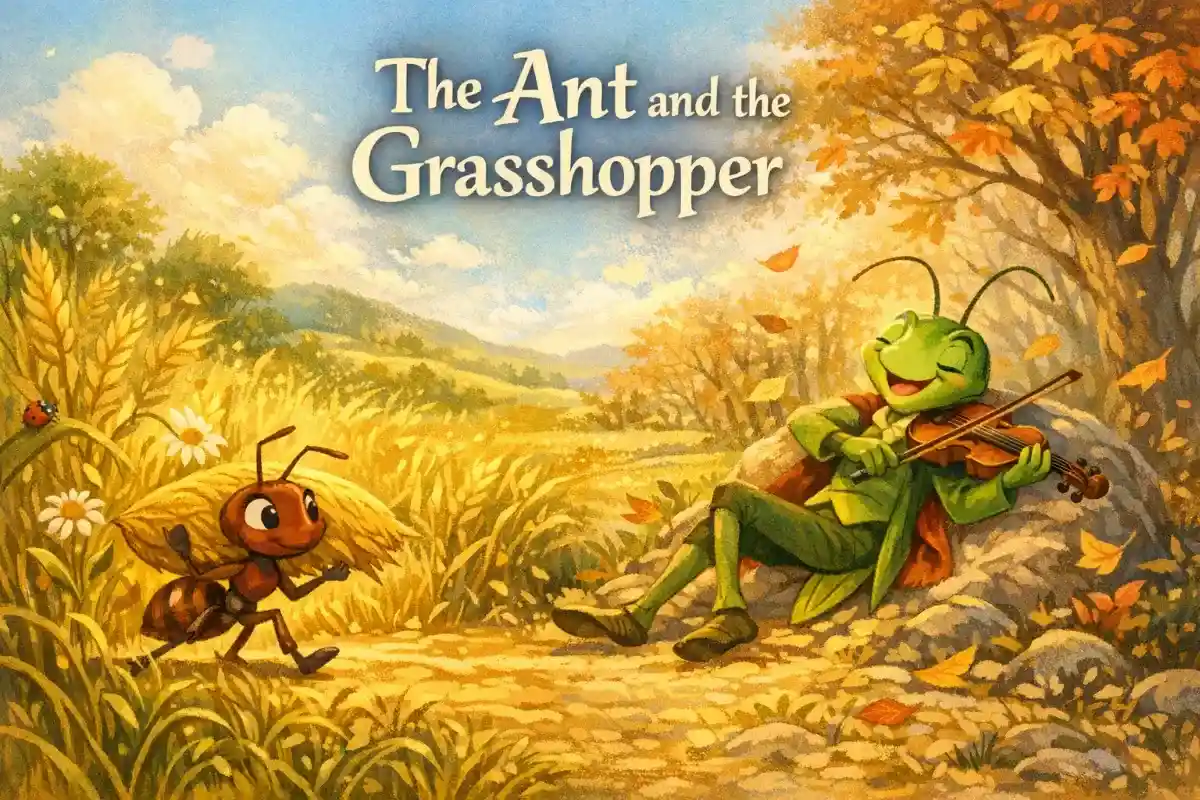
Once, in a wide and sunlit meadow, there lived a lively grasshopper who spent his days leaping through the tall grass, singing cheerful songs and playing his fiddle.
The air was warm, the sky was bright, and he felt there was nothing better to do than enjoy the moment.
Nearby, a small ant moved steadily along the ground. Back and forth she went, carrying grains of wheat, tiny seeds, and bits of food much larger than herself.
She worked quietly, without stopping, storing everything carefully in her underground home.
One day, the grasshopper paused his music and watched her.
“Why do you work so hard on such a beautiful day?” he asked with a laugh. “Come, sit with me. Enjoy the sunshine while it lasts.”
The ant stopped for just a moment and looked at him.
“I am gathering food for the winter,” she replied calmly. “When the cold days come, there will be nothing left to eat.”
The grasshopper waved his hand carelessly.
“Winter is far away,” he said. “There is plenty of time for that later. Right now, the fields are full, and the days are warm. You worry too much.”
And with that, he lifted his fiddle again and began to play, filling the meadow with lighthearted music.
But the ant returned to her work.
Day after day, the grasshopper sang and danced, enjoying the easy days of summer. And day after day, the ant carried food back to her home, preparing quietly for what was to come.
As time passed, the seasons began to change.
The warm breeze turned cooler. The bright green leaves slowly became gold and brown. The sun set earlier each evening, and the nights grew longer.
Still, the grasshopper continued to play.
“There is still time,” he told himself.
But soon, winter arrived.
A cold wind swept across the meadow. The ground became hard, and a blanket of snow covered the fields.
The grasshopper searched for food, but there was nothing to be found. The plants had withered, and the earth was frozen.
Hungry and shivering, he wandered through the snow.
At last, he came upon the ant’s home.
He knocked weakly at the door.
When the ant opened it, she saw the grasshopper trembling in the cold.
“Please,” he said, his voice thin and tired, “I have no food, and I cannot survive this winter. Will you help me?”
The ant looked at him for a moment.
“What did you do during the summer,” she asked, “when I was working and storing food?”
The grasshopper lowered his head.
“I sang,” he admitted quietly. “I played my music and enjoyed the days.”
The ant gave a small, thoughtful nod.
“Then perhaps,” she said, “you should dance now.”
And with that, she closed the door.
Left outside in the cold, the grasshopper realized too late the cost of his carefree days.
And so, the lesson was clear:
Those who spend their time only in pleasure, without thought for the future, may one day find themselves unprepared when life grows difficult.
👉 Keep reading here: Bedtime Stories for Kids: 10 Calming Stories for Sleep
Why Classic stories for kids like The Ant and the Grasshopper work so well at bedtime
When your child is already in bed, the goal is not stimulation—it’s calm.
That’s why Classic stories for kids like this one are so helpful.
The structure is simple.
The rhythm is steady.
The emotions are soft and predictable.
Your child doesn’t have to work hard to follow the story. That makes it easier for their mind to slow down.
There are no sudden surprises.
No loud moments.
Just a gentle flow from beginning to end.
And that is exactly what helps your child relax.
👉 Keep reading here: Educational Stories for Kids: 10 Tales That Teach Values
The Ant and the Grasshopper fable and how it teaches without overwhelming
The beauty of The Ant and the Grasshopper fable is that it teaches quietly.
There is no pressure.
No long explanation.
Just a simple contrast:
One character prepares calmly.
The other learns slowly.
That’s enough.
At bedtime, your child doesn’t need a lesson explained in detail.
They simply need to feel it.
You can softly reflect after the story:
“The ant stayed calm and ready.”
“The grasshopper learned, and that’s okay.”
This keeps the moment gentle and safe.
Classic stories: The Ant and the Grasshopper in a calm bedtime routine
If your evenings feel a little chaotic, this is where a simple story can help more than you expect.
You don’t need a perfect routine.
Just something consistent.
You might dim the lights.
Sit beside your child.
Speak a little slower than usual.
Let your voice soften as the story continues.
Stories like Classic stories: The Ant and the Grasshopper naturally guide your tone.
Warm at the beginning.
Quieter as the story goes on.
Soft and still at the end.
That shift alone helps your child’s body begin to relax.
👉 Keep reading here: Short Stories for Kids: 10 Calm Tales for Sleep
The ant and the grasshopper story and emotional safety before sleep
One of the biggest concerns parents have at bedtime is overstimulation.
Too much noise.
Too much excitement.
Too many screens.
A calm The ant and the grasshopper story does the opposite.
It slows everything down.
It creates a quiet emotional space.
Your child feels:
Safe
Held
Calm
Even if your child is a little restless, your voice and the rhythm of the story begin to guide them toward stillness.
👉 Keep reading here: Animal Stories for Kids: 10 Heartwarming Tales
The Ant and the Grasshopper full story as a tool to reduce bedtime resistance
If your child often resists bedtime, you are not alone.
Many children struggle with the transition from activity to rest.
A predictable story helps signal:
“This is the end of the day.”
When you read The Ant and the Grasshopper full story regularly, your child begins to recognize the pattern.
Story = calm
Calm = sleep
Over time, this reduces resistance.
Not instantly.
But gently and consistently.
👉 Keep reading here: Bedtime Stories for Babies: 10 Gentle Tales for Fast Sleep
How to use this story tonight (simple and realistic)
You don’t need to change everything.
Just try this:
Sit close to your child
Lower your voice slightly
Read slowly
Pause between sentences
If your child asks questions, answer softly, then return to the story.
If they move around, that’s okay.
Stay calm.
Keep reading gently.
Even if they don’t fall asleep right away, their body is still slowing down.
And that matters.
When your child feels too energetic at night
Some nights are harder.
Your child might talk more.
Move more.
Resist more.
That doesn’t mean the routine isn’t working.
It just means they need more calm.
You can:
Slow your reading even more
Repeat a few lines softly
Let your voice become quieter toward the end
The goal is not perfection.
The goal is calm repetition.
A quiet connection that matters more than perfection
At the end of the story, you don’t need to do much.
You might softly say:
“That was a calm story.”
“The ant was safe and prepared.”
Then just sit for a moment.
That silence matters.
It helps your child transition from listening… to resting… to sleeping.
And more than anything, it creates a feeling of connection.
Conclusion
At the end of a long day, what your child needs most is not something impressive—it’s something gentle.
A calm voice.
A soft story.
A predictable moment that feels safe.
The Ant and the Grasshopper is more than just a classic.
It’s a simple way to bring quiet, balance, and comfort into your child’s bedtime routine.
You don’t need to do it perfectly.
You just need to show up, sit close, and share the moment.
And as your child slowly closes their eyes, that gentle rhythm—the story, your voice, the calm—becomes something they can trust.
Night after night.
FAQs
What age is The Ant and the Grasshopper best for?
This story works well for children ages 4 to 8. Younger children can still enjoy it if you keep your tone soft and simple.
How long should a bedtime story be?
About 5 to 10 minutes is enough. The goal is to create calm, not to tell a long story.
Should I explain the lesson after reading?
No need for long explanations. A short, gentle comment is enough. Let your child absorb the message naturally.
Can I read the same story every night?
Yes. Repetition actually helps children feel safe and fall asleep faster.