
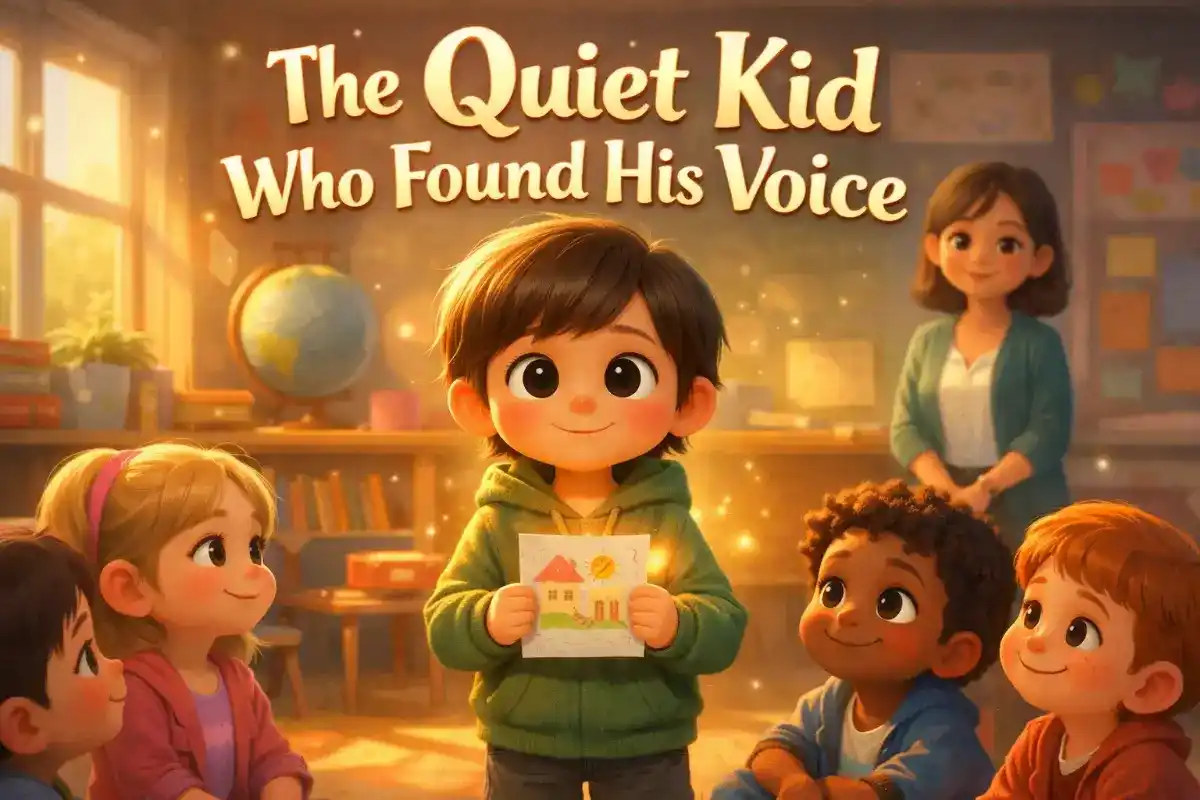
At the end of a long day, when your child is finally in pajamas and the house feels a little quieter, you don’t need something loud or complicated.
You need something gentle. Something safe. Something you can use tonight.
That’s why Educational stories for children can be such a gift at bedtime. They don’t just fill time. They help your little one settle, feel understood, and rest.
If your child is shy, sensitive, or still learning how to speak up, this story was written for this very moment.
You can read it slowly, softly, and let it become part of a calm and predictable bedtime routine.
Educational stories for children: The Quiet Kid Who Found His Voice

There once was a little boy named Oliver.
Oliver liked quiet things.
He liked watching the clouds move slowly across the sky.
He liked lining up his toy cars in careful rows.
He liked sitting close to his mom and listening.
At school, Oliver did not talk very much.
When the teacher asked questions, other children raised their hands quickly.
Oliver kept his hands in his lap.
He had thoughts.
He had ideas.
But they felt small inside him, like tiny birds not ready to fly.
One morning, the class was asked to draw their favorite animal.
Oliver drew a sea turtle.
He drew it swimming calmly through blue water. He added tiny bubbles. He added soft sea plants moving gently in the ocean.
When it was time to share, Oliver felt his chest get tight.
His teacher smiled kindly.
“Would anyone like to tell us about their drawing?” she asked.
Hands went up.
Oliver looked at his picture. He loved his turtle. But his voice felt far away.
He shook his head slightly.
That afternoon, Oliver’s mom noticed he was quiet.
“Was something hard today?” she asked gently.
Oliver nodded.
“I wanted to talk,” he whispered. “But my words wouldn’t come out.”
His mom sat beside him on the couch.
“Sometimes,” she said softly, “voices grow slowly. Like seeds.”
She put her hand over his heart.
“Your voice is in there. It just needs time.”
That night, before bed, Oliver held his turtle drawing again.
He imagined the turtle swimming calmly.
Turtles don’t rush.
They move slowly. Steady. Safe.
The next day, the teacher announced a new activity.
“We’re going to work in pairs,” she said.
Oliver was paired with a quiet girl named Mia.
Mia looked at Oliver and smiled softly.
They both looked at their paper.
After a moment, Mia whispered, “What do you think we should draw?”
Oliver felt the tiny bird inside his chest flutter.
He swallowed.
“We could draw… the ocean,” he said quietly.
Mia’s eyes lit up.
“That’s a great idea.”
Oliver felt something warm spread inside him.
They worked together. They drew waves. Fish. Sea plants.
When it was time to share, Mia looked at Oliver.
“Do you want to tell them about the turtle?” she asked gently.
Oliver felt his heart beat fast.
He remembered his mom’s words.
Seeds grow slowly.
He took a small breath.
“This is a sea turtle,” he said softly. “They swim very far. And they always find their way home.”
The room was quiet.
Then the teacher smiled.
“Thank you for sharing, Oliver,” she said.
No one laughed.
No one rushed him.
Everyone listened.
That night, Oliver told his mom the whole story.
His voice was still soft.
But it was there.
And each day after that, his tiny bird grew stronger.
Not loud.
Not fast.
Just steady.
Just right.
And Oliver learned that being quiet did not mean being invisible.
It simply meant his voice was thoughtful.
And when he used it, people listened.
The end.
👉 One more story for tonight: Educational Bedtime Stories for Kids: 10 Soothing Tales
Why Educational Stories for Children Help at Bedtime
If your child takes a long time to fall asleep, it may not be about energy.
Sometimes it’s about feelings.
Shy children often carry quiet worries into the night.
Sensitive children replay moments in their minds.
Children who struggle to speak up may feel small inside.
Educational bedtime stories for kids like this one do something important.
They say, gently:
“You are okay exactly as you are.”
There is no villain here.
No danger.
No loud surprise.
Just a slow story about growth.
That calm structure helps your child’s body relax.
👉 One more story for tonight: Bedtime Stories for Kids: 10 Calming Stories for Sleep
How to Use This Story Tonight in a Calm Bedtime Routine
You do not need a perfect routine.
You just need something predictable.
Here is a simple way to use this story tonight:
Bath or warm wash.
Pajamas.
Lights dimmed.
One short educational story.
Soft goodnight words.
When you read, lower your voice a little more with each page.
Pause after important lines like:
“Seeds grow slowly.”
Let the silence sit for a moment.
That pause is powerful.
If your child gets overstimulated easily, avoid reading with dramatic voices. Keep everything soft and steady.
You can even place your hand gently on your child’s back while reading.
Touch plus voice creates safety.
👉 One more story for tonight: Short Stories for Kids: 10 Calm Tales for Sleep
If Your Child Is the “Quiet Kid”
You may worry.
You may wonder if your child speaks enough.
If they are confident enough.
If they will struggle socially.
At bedtime, those worries can feel heavy.
This story gives you a way to talk about it without pressure.
After reading, you might softly say:
“Sometimes voices grow slowly. That’s okay.”
No long lesson.
No lecture.
Just reassurance.
Educational kids stories at home should feel like comfort, not correction.
Keeping Bedtime Calm and Screen-Free
If evenings have become loud or rushed, small changes help.
Instead of ending the day with bright screens, try ending it with one calm story.
Short educational stories are especially helpful because they are focused. Clear. Gentle.
Your child’s brain shifts from stimulation to rest.
If you’re exhausted, remember this:
You don’t need to read perfectly.
You just need to show up.
Your steady presence matters more than dramatic storytelling.
👉 One more story for tonight: Classic Bedtime Stories: 15 Timeless Tales to Calm Kids
When Your Child Asks Questions After the Story
Sometimes, quiet children open up at night.
They might whisper:
“Why was Oliver scared?”
You can answer simply:
“Because speaking can feel big sometimes.”
If your child says:
“I don’t like talking in class.”
You can say:
“That’s okay. Your voice will grow.”
Keep your tone calm.
Bedtime is not the moment to solve everything.
It is the moment to create safety.
👉 One more story for tonight: Animal Stories for Kids: 10 Heartwarming Tales
Why Gentle Learning Stories Work Better Before Sleep
Learning stories for kids don’t need to teach loudly.
At bedtime, the goal is not achievement.
It is connection.
This story teaches:
Patience.
Self-acceptance.
Steady growth.
All without pressure.
That is why it works at night.
Your child can rest without feeling judged or compared.
👉 One more story for tonight: Bedtime Stories for Babies: 10 Gentle Tales for Fast Sleep
FAQs for Parents Tonight
What age is this story best for?
It works beautifully for ages 3 to 8.
For toddlers, shorten sentences and simplify details.
For older children, you can talk a little more about feelings.
How long should bedtime stories be?
Five to ten minutes is enough.
If your child takes a long time to fall asleep, resist adding more and more stories.
Repetition is more calming than variety.
What if my child is not shy?
That’s okay.
This story still teaches patience and thoughtful speaking.
Every child benefits from hearing that their voice matters.
Is this safe for sensitive children?
Yes.
There is no scary content. No harsh consequences.
The emotional tone stays gentle from beginning to end.
A Soft Ending for Tonight
Right now, your house may finally be quiet.
Your child may be curled under a blanket, eyes half closed.
You may still be carrying the weight of the day.
Reading a story like this is not just about helping your child.
It is about slowing the world down for both of you.
When you whisper, “Seeds grow slowly,” you are not only talking about Oliver.
You are reminding your child that growth takes time.
And you are reminding yourself that you are doing enough.
Bedtime does not need to be perfect.
It just needs to feel safe.
Tonight, let your voice be soft.
Let the room be calm.
Let the day end gently.
Your child is listening.
And that quiet moment between you — that is where real rest begins.