
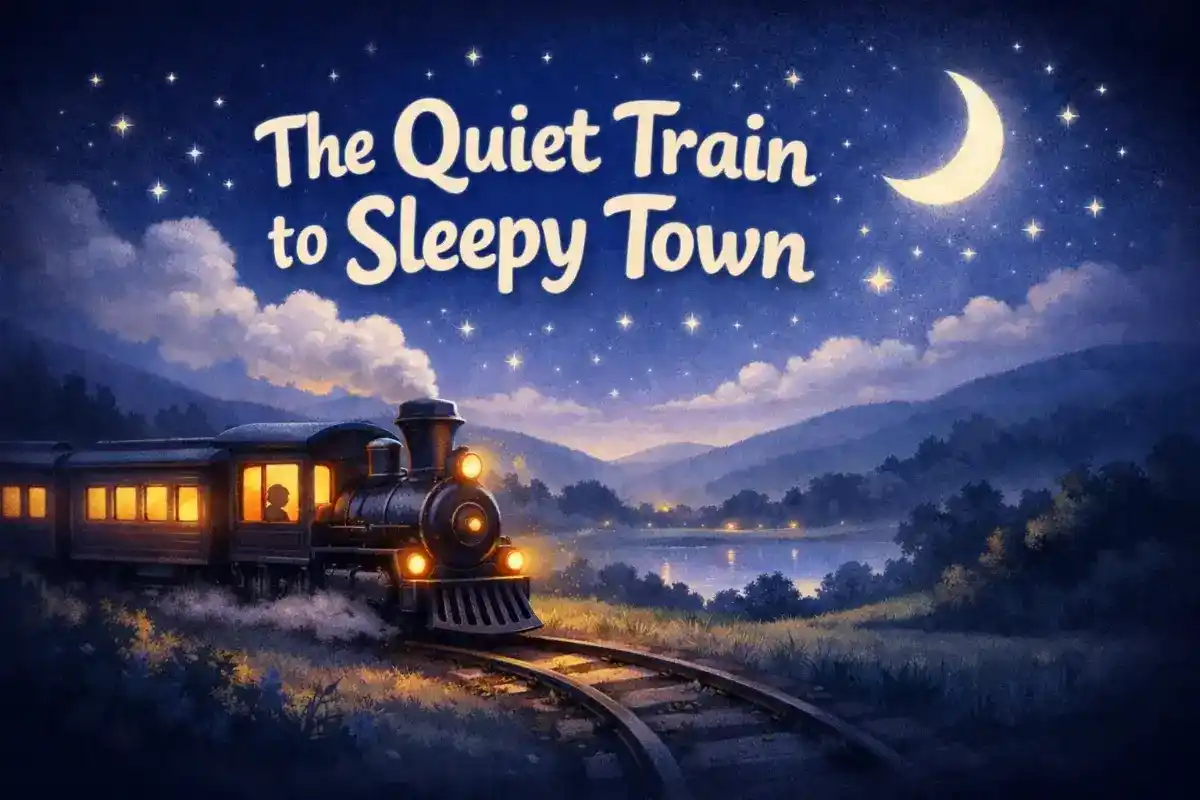
When the lights are dim and your little one is already in pajamas, you may be searching for Short bedtime stories for kids that truly help with sleep.
Not something silly. Not something loud. Just something calm and safe.
If your child takes a long time to fall asleep, asks for one more book, or feels restless at night, this story is something you can use right now.
Take a slow breath.
You can read this softly. You can read this tonight.
Short bedtime stories for kids: The Quiet Train to Sleepy Town
Lower your voice just a little as you begin.
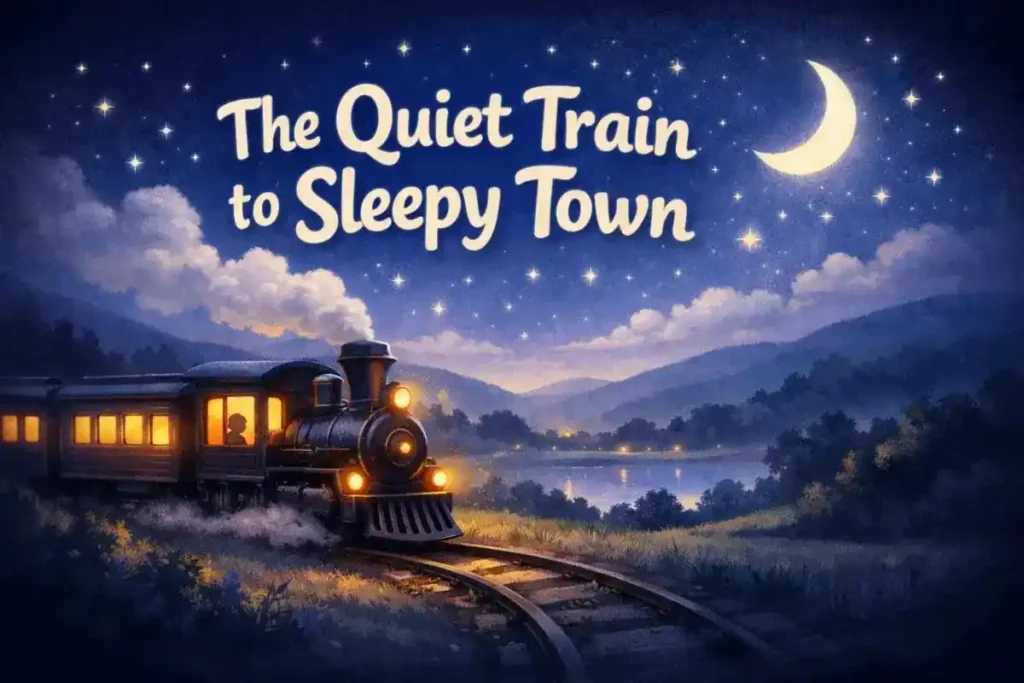
In a small station at the edge of a quiet village, there waited a gentle night train.
It was not fast.
It did not whistle loudly.
It did not rush.
It was called the Quiet Train.
Every night, just as the sky turned deep blue and the stars began to shine, the Quiet Train prepared for one simple journey.
It traveled to Sleepy Town.
The train cars were small and cozy. Each window glowed with a warm golden light.
Inside the first car sat a little gray rabbit, already wrapped in a soft blanket.
In the second car, a tiny fox yawned and leaned against a pillow.
In the third car, a small child with sleepy eyes looked out the window at the moon.
The conductor moved slowly down the aisle.
“Tickets, please,” he whispered gently.
But these were not paper tickets.
Each passenger carried something small and invisible.
A yawn.
A heavy eyelid.
A quiet breath.
The train doors closed with a soft click.
And the Quiet Train began to move.
Chug… chug… chug…
Not loud.
Not fast.
Just steady.
The wheels turned slowly along the silver tracks that shimmered in the moonlight.
Outside, the world grew quieter.
Houses dimmed their lights.
Trees swayed gently.
Even the wind seemed to whisper.
Inside the train, the rabbit’s eyes fluttered.
The fox stretched and curled into a small ball.
The child in the third car watched the stars drift by.
The conductor dimmed the lights just a little.
“Next stop,” he said softly, “Sleepy Town.”
The train crossed a small bridge over a calm river.
The water below reflected the moon like a mirror.
Back and forth, the train rocked gently on the tracks.
Back and forth.
The rhythm felt steady.
Safe.
The passengers did not speak.
They listened to the quiet hum of the wheels.
They felt the soft rocking beneath them.
The child in the third car leaned against the window.
The glass felt cool.
The stars looked closer now.
The train slowed as it reached a small platform surrounded by glowing lanterns.
A wooden sign read: Sleepy Town.
The doors opened quietly.
The rabbit stepped out and disappeared into a cozy burrow.
The fox padded softly into a warm den.
The child walked down a short lantern-lit path toward a little house with glowing windows.
The conductor tipped his hat.
“Rest well,” he whispered.
The Quiet Train did not rush back.
It stayed still for a moment.
The night wrapped around it like a soft blanket.
And in Sleepy Town, every passenger drifted into calm, gentle dreams.
The train rested too.
Until tomorrow night.
👉 A story your child may love: Short Stories for Kids: 10 Calm Tales for Sleep
Why Short Stories for Kids Help the Body Slow Down
A short sleep story works best when it has rhythm.
This story moves like a train.
Slow.
Steady.
Predictable.
Children respond to repetition and gentle pacing.
When your child hears “Chug… chug… chug…” in a soft voice, their breathing may begin to match that rhythm.
This is why many of the best short stories for kids at night include movement that rocks or sways.
Rocking signals safety.
Steady signals rest.
👉 A story your child may love: Bedtime Stories for Kids: 10 Calming Stories for Sleep
If Your Child Gets Overstimulated Before Bed
Some children become more energetic as bedtime approaches.
It can feel confusing.
You may wonder if you are doing something wrong.
You are not.
Often, their body is tired, but their mind is still active.
That is where short sleep stories for kids help.
Before reading tonight, try this:
- Turn off overhead lights.
- Use a small lamp or nightlight.
- Sit close so you can speak softly.
- Avoid bright pictures or screens.
Then read this short story for kids slowly.
If your child interrupts, respond gently, then return to the story without excitement.
The goal is calm, not performance.
👉 A story your child may love: Bedtime Stories for Babies: 10 Gentle Tales for Fast Sleep
Creating a Predictable Bedtime Pattern
Children feel safer when they know what happens next.
You do not need a long routine.
You need a consistent one.
You might try:
- Pajamas.
- Bathroom.
- One short story.
- One hug.
- One goodnight phrase.
That is enough.
If your child asks for another book, you can softly say:
“Tonight we ride the Quiet Train once. Tomorrow night, we ride again.”
Consistency builds trust.
Trust builds calm.
Choosing the Right Short Story for Kids at Night
Not all short stories for kids are designed for bedtime.
Some are funny.
Some are adventurous.
Some are loud.
For sleep, look for stories that include:
- Gentle movement.
- Soft repetition.
- No danger.
- A peaceful ending.
The Quiet Train has no villains.
No sudden noises.
No surprises.
It simply travels from awake to asleep.
That is the journey your child is making too.
👉 A story your child may love: Classic Bedtime Stories: 15 Timeless Tales to Calm Kids
When You Feel Too Tired to Read
Some nights are heavy.
If you are exhausted, you can shorten the story.
You can say:
“There was a quiet train. It moved slowly to Sleepy Town. Everyone stepped off and went to rest.”
That is enough.
Your steady voice is what matters most.
Even a short sleep story whispered softly can help your child feel safe.
👉 A story your child may love: Educational Bedtime Stories for Kids: 10 Soothing Tales
Helping Your Child Transition After the Story Ends
Sometimes the hardest part is not the story.
It is the moment after.
When the book closes, your child may suddenly seem awake again.
Here is something simple you can try tonight:
After the last line, keep your hand gently on your child’s back.
Count three slow breaths in silence.
Then whisper:
“The train has arrived. Your body can rest.”
Use the same phrase every night.
Over time, those words will carry calm on their own.
👉 A story your child may love: Animal Stories for Kids: 10 Heartwarming Tales
Ideal Age for This Story
This story works beautifully for ages 2 to 6.
For toddlers:
Shorten it. Focus on the rhythm. Repeat “Chug… chug… chug…”
For preschoolers:
Read the full version slowly.
For older children who still need help settling:
Let them imagine what their own Sleepy Town looks like.
But keep the conversation for daytime.
Night is for quiet.
How Many Stories Should You Read?
If bedtime feels long and difficult, start with one short bedtime story.
More stories can sometimes wake the brain again.
If bedtime is already smooth, you may add a second very short one.
But keep the structure the same every night.
One story.
One cuddle.
One phrase.
Predictable.
Calm.
Safe.
Content Safety and Emotional Security
You may worry about inappropriate themes.
You may want to avoid screens before bed.
That instinct is wise.
Short bedtime stories for kids that focus on calm imagery help protect your child’s emotional space at night.
No intense emotions.
No sarcasm.
No loud humor.
Just gentle storytelling.
Your child deserves to fall asleep feeling safe.
FAQs About Short Bedtime Stories for Kids
How long should a short bedtime story be?
Five to seven minutes is usually enough. Long enough to transition, short enough to prevent overstimulation.
What if my child wants to talk during the story?
You can respond briefly and gently. Then guide back to the rhythm. Keep your voice calm.
Are sleep stories for kids better than regular stories?
At bedtime, yes. Stories written with calm pacing and soft endings help the body slow down more effectively.
What if my child is still awake?
That is okay. The goal is not instant sleep. The goal is calm. Sleep will follow with consistency.
A Soft Closing for Tonight
Right now, your little one may be lying beside you.
The room is dim.
The day is done.
You do not need to solve every bedtime challenge tonight.
You only need one gentle moment of connection.
When you read The Quiet Train to Sleepy Town, you are offering your child rhythm.
You are offering predictability.
You are offering safety.
And in the quiet space after the final word, when your child’s breathing grows slower, something steady and beautiful is happening.
Trust is growing.
Calm is settling.
The train has arrived.
The lights are dim.
Your child is safe.
And it is time to rest.